INTRODUCTION TO COMMUNICATION
| Site: | The Communicator’s Classroom |
| Course: | The Communicator’s Classroom |
| Book: | INTRODUCTION TO COMMUNICATION |
| Printed by: | |
| Date: | Saturday, 8 August 2026, 1:43 PM |
1. INTRODUCTION TO COMMUNICATION
What is communication?
Communication is the process of exchanging information among people through a given medium.
According to Silas Saleem, communication is the process of giving, receiving, or exchange of information, opinion or ideas by writing, speech or visual means or any combination of the two, so that material communicated is completely understood by everyone concerned. The information transmitted may be in a form of pictures, writings, audio, videos, or symbols.
The medium used might be verbal (oral) communication, written communication, visual communication, audio-visual communication, or non-verbal communication.
Objectives/purposes of effective communication
i) To inform/educate – through communication, individuals get to know and learn about something. For example, a manager informing workers on the new changes in an organization.
ii) To persuade/influence – through communication, someone can convince others into agreeing with their ideas or doing something. For instance, advertisements persuade customers to purchase certain products.
iii) To express emotions and feelings -individuals can share their feelings and emotions they go through by communicating with others. For example, a grieving individual can share their sorrow with others and receive comfort.
i) To build and sustain relationships –through communication, individuals can create and maintain relationships. For example, employees at work may make new friends through exchanging of interests and ideas.
ii) To enable decision-making - through communication, certain decisions can be made after discussions. The leadership of an organization, for instance, may come together and discuss the action to be taken against an indiscipline employee.
iii) To facilitate problem-solving – through communications, individuals are able to put their minds together and solve issues. For instance, a company’s management may come together to handle theft within an organization.
iv) To Enhance coordination/collaboration – through communication, organization can plan events of functions together. For example, Kenya Red Cross and Kenya army coordinating disaster response during emergencies.
2. 2. THE COMMUNICATION PROCESS
Communication is a process and not just an instantaneous process. It involves a series of specific steps as seen in the communication cycle diagram.
Elements of communication
i) Sender / Source – The person who initiates the action of communication and sends the message.
ii) Message / Content – The information, idea, or thought that the sender wishes to communicate to the receiver.
iii) Channel/Medium – The means or method through which the message is transmitted, such as spoken words, written text, or visual means.
iv) Receiver / Audience– The person or group for whom the message is intended.
v) Feedback – The receiver's response to the message. The reply/reaction to the message.
Communication process
As mentioned in the introduction, communication is a process and not just an instantaneous activity.
The communication process is initiated by the sender who formulates a message and transmits it through a selected channel. The receiver then interprets the message and provides feedback through an appropriate channel. This cycle may continue depending on the communicators.
For example, in an organization, a manager may send an email (written communication) to employees regarding a new policy. The employees read the message, interpret its meaning, and may seek clarification or simply adopt the policy hence completing the communication cycle.
Source
The source is the originator of the message. It is the person or persons who want to communicate a message to another person or a group of people. The source of a message can be an individual speaker addressing a group, a child asking for candy, a couple sending out invitations to a family reunion, or a person writing a letter.
Encoding
Once the source has decided on a message to communicate, he must encode or convert that idea, thought, or feeling into verbal and nonverbal symbols that will be most effectively understood by the receiver. This encoding process can be extremely creative because there are unlimited ways for the source to convert the idea or feeling into words and behaviors.
Message
The message is the idea, thought, or feeling that the source wants to communicate. This message is encoded or converted into verbal and nonverbal symbols that will most likely be understood by the receiver.
Receiver
The receiver is the recipient of the message. The receiver can be an individual or a group of people. Once the receiver hears the words and receives the nonverbal cues from the sender, she must interpret or decode them if communication is to occur.
Decoding
Decoding is the process of making sense out of the message received. The receiver must decipher the language and behaviors sent by the source so they will have meaning. After the receiver decodes the message, the receiver (now the source) can encode a return message and send it back to the other person.
Channel
A channel is the medium by which the message is communicated. The source can utilize the channels of sight, sound, touch, smell, and taste. For instance, if you want to communicate affection for another person, you can utilize a variety of channels or combination of channels. You can say, “I like you” (sound). You can give a hug (touch). You can wink an eye (sight). You can send cookies that you baked (taste). Or you can deliver a dozen roses (smell). You can creatively select the channels of communication to productively communicate your message.
Context/Environment
All communication occurs within a certain context. The context is made up of the physical surroundings, the occasion in which the communication occurs, the time, the number of people present, noise level, and many other variables that can influence and affect the encoding and decoding of messages. The context plays an important role in the communication process.
Feedback
The receiver also feels a reaction to the message; this reaction may be conscious or unconscious; it may cause some change in the receiver's facial expression. It definitely leads the receiver to think. The receiver may take some action, if required. He may also reply to the message. The response and/or reply is feedback. Receiver's functions complete one cycle of the process of communication.
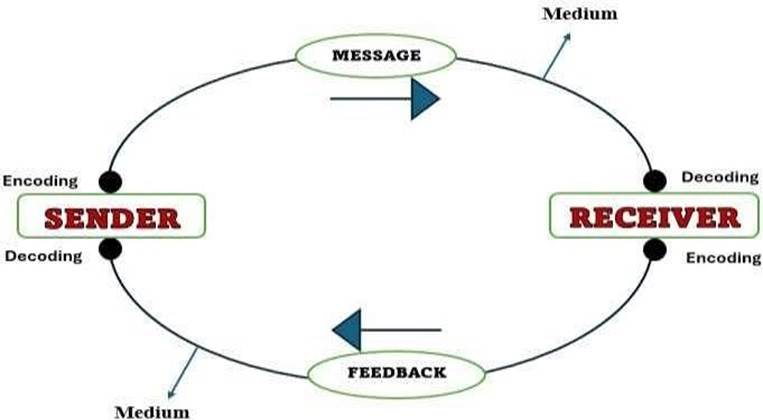
Figure 1. Communication cycle
2.1. Principles of effective communication
Communication is effective only when both the sender and the receiver are focused on the act of communication.
The qualities of communication which the sender must achieve are called the C's of Communication because most of them begin with the letter C.
Cs of Good Communication
- Clarity – It ensures that the message/feedback is simple and easy to understand. Clarity ensures that the message/feedback has one meaning/interpretation (i.e. not ambiguous). For clarity, avoid jargons (complex terms) that may confuse the receiver.
a. The message must be clear at the first reading so it that takes very little time to follow and understand. Clearly written or spoken messages avoid misunderstanding and save time. Write and speak to express, not to impress. Clarity depends upon these factors: Simple, common everyday words which everyone can understand, short and simple sentences. Long sentences confuse the reader, and often confuse the writer also and proper punctuation and pauses. It helps to provide pauses and stops and to break up groups of words into sensible units.
- Conciseness – This principle ensures that only the necessary details are included in the message, making the message short and direct to the point. For conciseness, too many repetitions and unnecessary examples.
a. Conciseness means expressing much in a few words; in business communication it means keeping to the point, using as few words as possible without sacrificing clarity or courtesy. It does not necessarily mean being brief; it means making every word count.
- Correctness – It ensures that the information is truthful. It ensures that information is right (accurate) in terms of language used, grammar used, measurements, amount etc. Correctness prevents misinterpretation of the message.
a. A letter must be correct in every respect: In spelling, grammar, pronunciation, and use of language, appearance and form of layout, . Incorrect language spoils the message, distracts the receiver's attention, and creates a poor impression of the sender; it may also convey a wrong meaning. Correctness also applied in the information conveyed correct and accurate. The tone, formality and style must be appropriate to the occasion.
- Completeness – This principle ensures that all relevant and necessary details are included in message/feedback such that the receiver canto understand and respond to the message appropriately.
- Courtesy – It ensures that the communicators use polite and respectful language. This promotes professionalism.
a. Courtesy is consideration for other people's feelings. It is seen in an individual's behaviour with others. A well-mannered and courteous person shows consideration and thought for others. In a letter, the style, the manner and the choice of words reflect the courtesy of the writer.
- Consideration – This principle ensures that the sender understands the communication needs/background of the receiver so as to be accommodative. The communicator must take into consideration communication needs such as age, religion, gender, education level, etc.
- Coherence – Coherence is logical sequence of ideas. Making a clear plan for a presentation or a letter ensures that the ideas are in logical order; coherence, that is, logical connection of ideas makes any composition easy to understand. Consistency in numbering also helps in achieving coherence.
2.2. The 7 Cs video
2.3. Importance of feedback
· It completes the whole process of communication and makes it continuous.
· It sustains communication process.
· It is a basis for measuring the effectiveness of communication.
· Feedback paves way for new idea generation.
· It is a good basis for planning on what next to be done especially statistical report.
2.4. Functions of the sender and receiver in the communication process
Functions of the sender in the communication process
· Encoding the Message
· Selecting the Communication Channel
· Knowing the Audience
· Ensure Clarity of the Message
· Seeking Feedback
Functions of receiver in the communication process
· Reception and Perception:
· Active Listening or Reading
· Decoding and Interpretation:
· Feedback Provision:
· Responsibility for Understanding the message