
INTRODUCTION TO COMMUNICATION
2. 2. THE COMMUNICATION PROCESS
Communication is a process and not just an instantaneous process. It involves a series of specific steps as seen in the communication cycle diagram.
Elements of communication
i) Sender / Source – The person who initiates the action of communication and sends the message.
ii) Message / Content – The information, idea, or thought that the sender wishes to communicate to the receiver.
iii) Channel/Medium – The means or method through which the message is transmitted, such as spoken words, written text, or visual means.
iv) Receiver / Audience– The person or group for whom the message is intended.
v) Feedback – The receiver's response to the message. The reply/reaction to the message.
Communication process
As mentioned in the introduction, communication is a process and not just an instantaneous activity.
The communication process is initiated by the sender who formulates a message and transmits it through a selected channel. The receiver then interprets the message and provides feedback through an appropriate channel. This cycle may continue depending on the communicators.
For example, in an organization, a manager may send an email (written communication) to employees regarding a new policy. The employees read the message, interpret its meaning, and may seek clarification or simply adopt the policy hence completing the communication cycle.
Source
The source is the originator of the message. It is the person or persons who want to communicate a message to another person or a group of people. The source of a message can be an individual speaker addressing a group, a child asking for candy, a couple sending out invitations to a family reunion, or a person writing a letter.
Encoding
Once the source has decided on a message to communicate, he must encode or convert that idea, thought, or feeling into verbal and nonverbal symbols that will be most effectively understood by the receiver. This encoding process can be extremely creative because there are unlimited ways for the source to convert the idea or feeling into words and behaviors.
Message
The message is the idea, thought, or feeling that the source wants to communicate. This message is encoded or converted into verbal and nonverbal symbols that will most likely be understood by the receiver.
Receiver
The receiver is the recipient of the message. The receiver can be an individual or a group of people. Once the receiver hears the words and receives the nonverbal cues from the sender, she must interpret or decode them if communication is to occur.
Decoding
Decoding is the process of making sense out of the message received. The receiver must decipher the language and behaviors sent by the source so they will have meaning. After the receiver decodes the message, the receiver (now the source) can encode a return message and send it back to the other person.
Channel
A channel is the medium by which the message is communicated. The source can utilize the channels of sight, sound, touch, smell, and taste. For instance, if you want to communicate affection for another person, you can utilize a variety of channels or combination of channels. You can say, “I like you” (sound). You can give a hug (touch). You can wink an eye (sight). You can send cookies that you baked (taste). Or you can deliver a dozen roses (smell). You can creatively select the channels of communication to productively communicate your message.
Context/Environment
All communication occurs within a certain context. The context is made up of the physical surroundings, the occasion in which the communication occurs, the time, the number of people present, noise level, and many other variables that can influence and affect the encoding and decoding of messages. The context plays an important role in the communication process.
Feedback
The receiver also feels a reaction to the message; this reaction may be conscious or unconscious; it may cause some change in the receiver's facial expression. It definitely leads the receiver to think. The receiver may take some action, if required. He may also reply to the message. The response and/or reply is feedback. Receiver's functions complete one cycle of the process of communication.
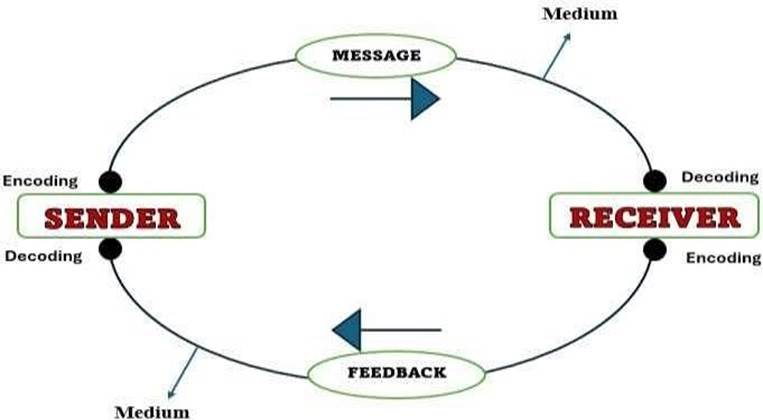
Figure 1. Communication cycle